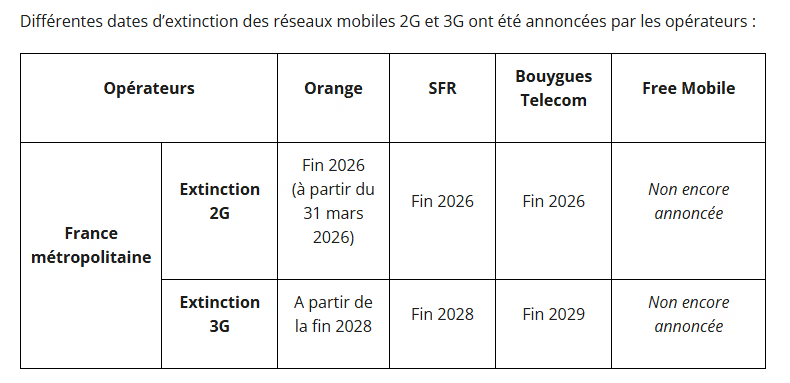
The 2G and 3G networks will be temporarily stopped between 2026 and 2027. Counters based on these technologies will no longer be able to send their data. This technical change is not trivial: it can cause an interruption of observatories, holes in the time series, and an obligation to renew sometimes recent parks. Many communities report that this change is causing an unexpected investment, even though they did not cause it.
Some providers are offering to migrate to 5G-compatible models. This technology, designed for consumer data, implies an increase in purchasing costs and greater consumption. It also reinforces the dependence on a renewal cycle dictated by telecom operators.
The challenge goes beyond connectivity: it raises the question of the total cost of ownership and the ability to guarantee continuity of service over 10 or 15 years.
Kiomda is adopting a different model. Our sensors are based on connectivity designed for increasingly connected objects, independent of the rapid changes in traditional mobile networks. This technology offers stable, consistent communication that is compatible with very low energy consumption.
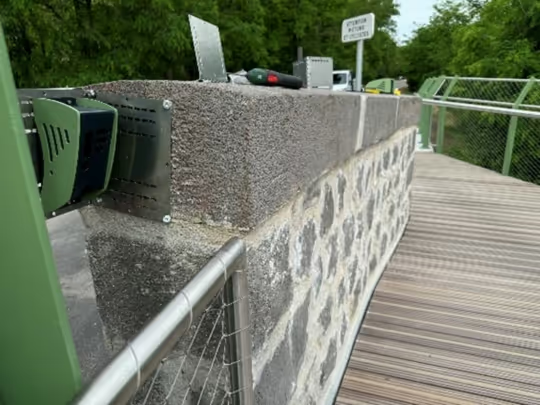
We made a clear industrial choice: to design an autonomous sensor that is simple to install and above all repairable. When a component needs to be replaced, the meter can be refurbished by postal mail, without work or technical travel. This architecture makes it possible to avoid complete renewals imposed by the stopping of a network or by the evolution of a modem.
A technological solution is not just a purchase: it is a commitment over time. The repairability of the meter, the stability of the connectivity and a warranty including parts and labor allow costs to be controlled throughout the life of the fleet.
This approach reduces total cost of ownership, protects the community from mobile network changes, and ensures that data will continue to accumulate without interruption.
Observatories rely on continuous time series. An interruption linked to the stopping of a network calls into question multi-year analyses, complicates reports, weakens diagnoses and can distort the evaluation of a development or a soft mobility project.
It is not only the sensor that stops: it is an entire observation device that is physically present. Sustainable technology is an essential condition for guaranteeing the robustness of the data used in planning.
Communities wishing to anticipate the 2G/3G end of life can consult:
— the page dedicated to Verdilo counter, to understand technology and its uses;
— Our page Rates, to assess total cost of ownership and compare scenarios.