English
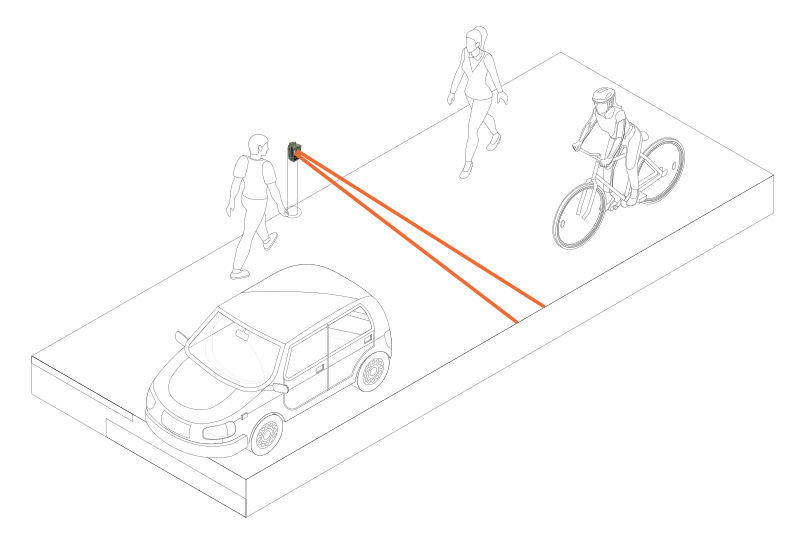
The Verdilo sensor performs best where vehicle flows are naturally channelled: narrow streets, car park entrances, site access points, shared routes, junction approaches and traffic-calmed zones. These are precisely the contexts where local authorities and site managers most frequently need traffic counts — to measure volumes, report on road issues, secure access points or assess the impact of infrastructure changes.
In most cases, yes — a natural passage point is sufficient.
Traffic flow, hourly peaks, seasonal trends, attractiveness.
No installation, no wiring. A single passage point is sufficient.
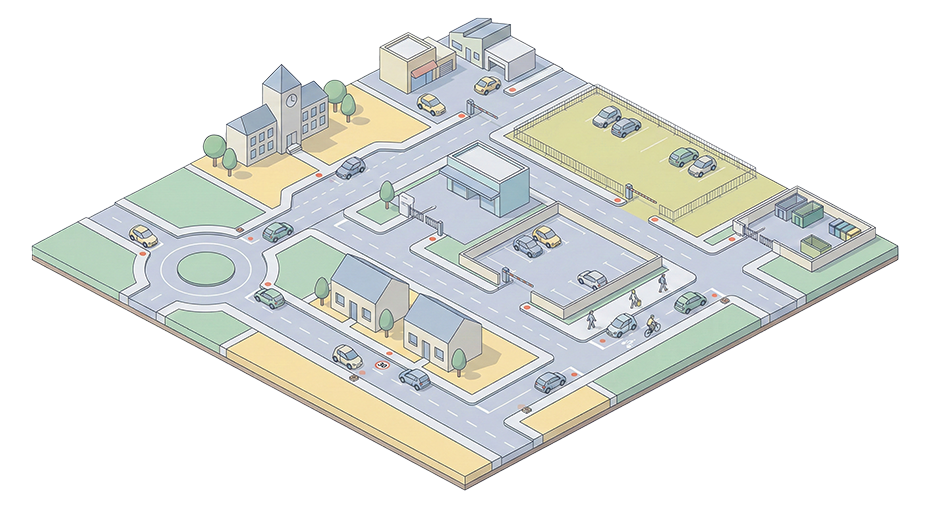

















Measuring motorised flows provides directly actionable information to understand how a road is actually used, improve safety, or adjust an improvement. Below are the most immediate and useful benefits for local authorities, site managers and companies.
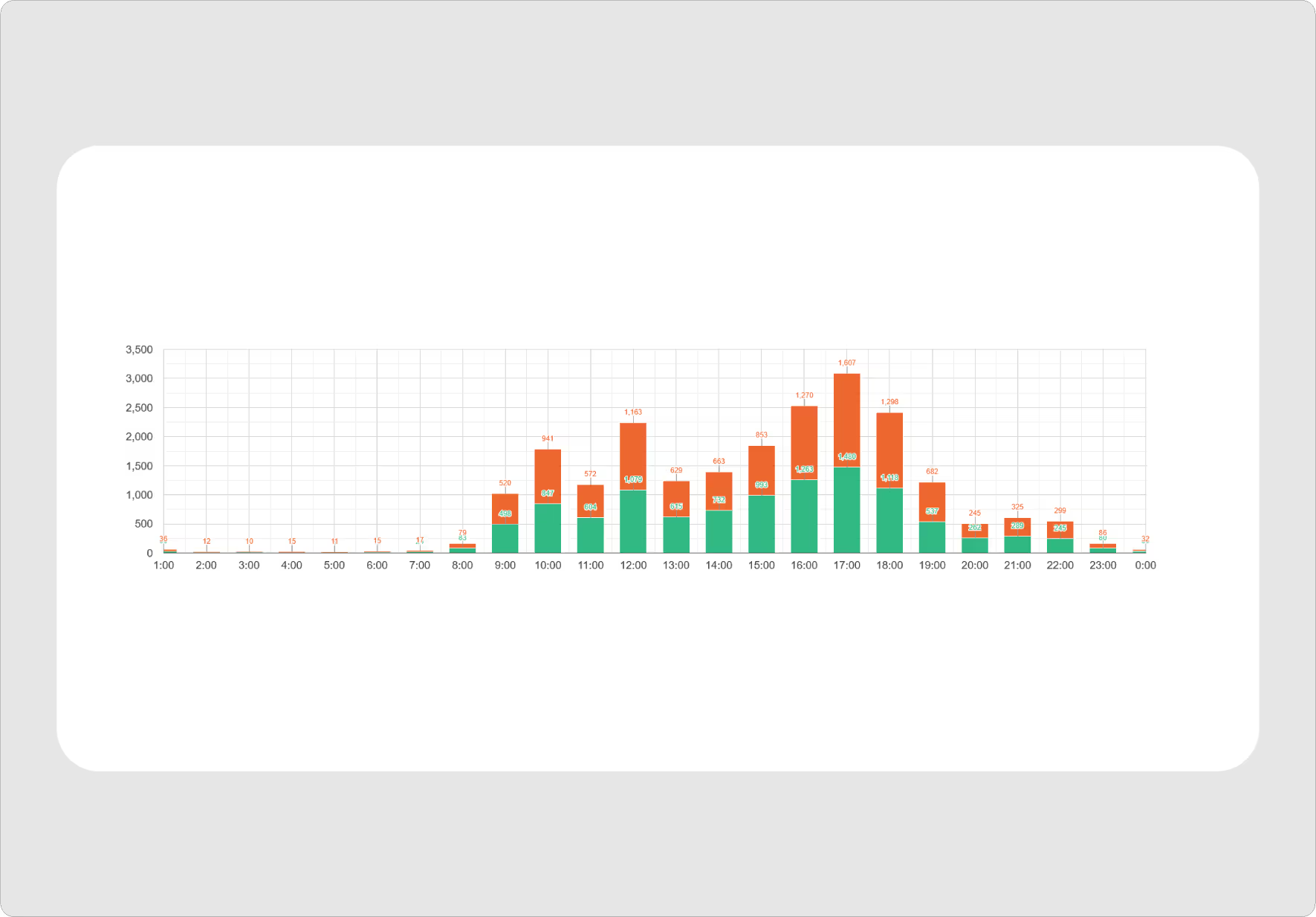
Vehicles per hour, day or season: an essential baseline to distinguish perception from reality, track trends or compare periods.
Morning peaks, evening peaks, irregular weekend flows, surges at parking entrances or near schools: data reveals when a site requires attention or adjustment.
Congested accesses, junctions where flows concentrate, saturated drop-off areas, heavily used recycling centre entrances: measurement helps prioritise where to act.
Traffic calming, direction changes, adding a cycle track, priority changes, chicanes, temporary restrictions: data supports objective before/after assessment.
Entries, exits, turnover and saturation periods: simple, essential data to adjust capacity, anticipate peaks or organise flows during events.
Data becomes a clear arbitration tool: justifying a project, responding to residents’ concerns, preparing public meetings or technical reports.
Technologies
Designed for outdoor environments, no installation or wiring required.

Operates without external power (estimated battery life of over 2 ).

Set up in 2 minutes, no expertise required, delivered ready to use.

Designed for outdoor conditions, in natural or urban environments.

No images recorded, GDPR compliant.

Capable of separately identifying pedestrians, cyclists, and vehicles, depending on the selected counting type.

Online consultation or local data collection in isolated areas.
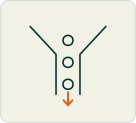
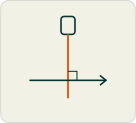
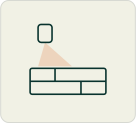
Thermal technology: the sensor reads the body heat of each user. The magnetometer detects the passage of metallic objects. No cameras, no images, no personal data.

Each passage is timestamped and classified by mode and direction.
Data is aggregated into 15-minute intervals directly within the device.
Depending on the chosen frequency (from 5 minutes to 24 hours), the device sends its data via the available network.
If no network is available, local Wi-Fi retrieval remains possible.
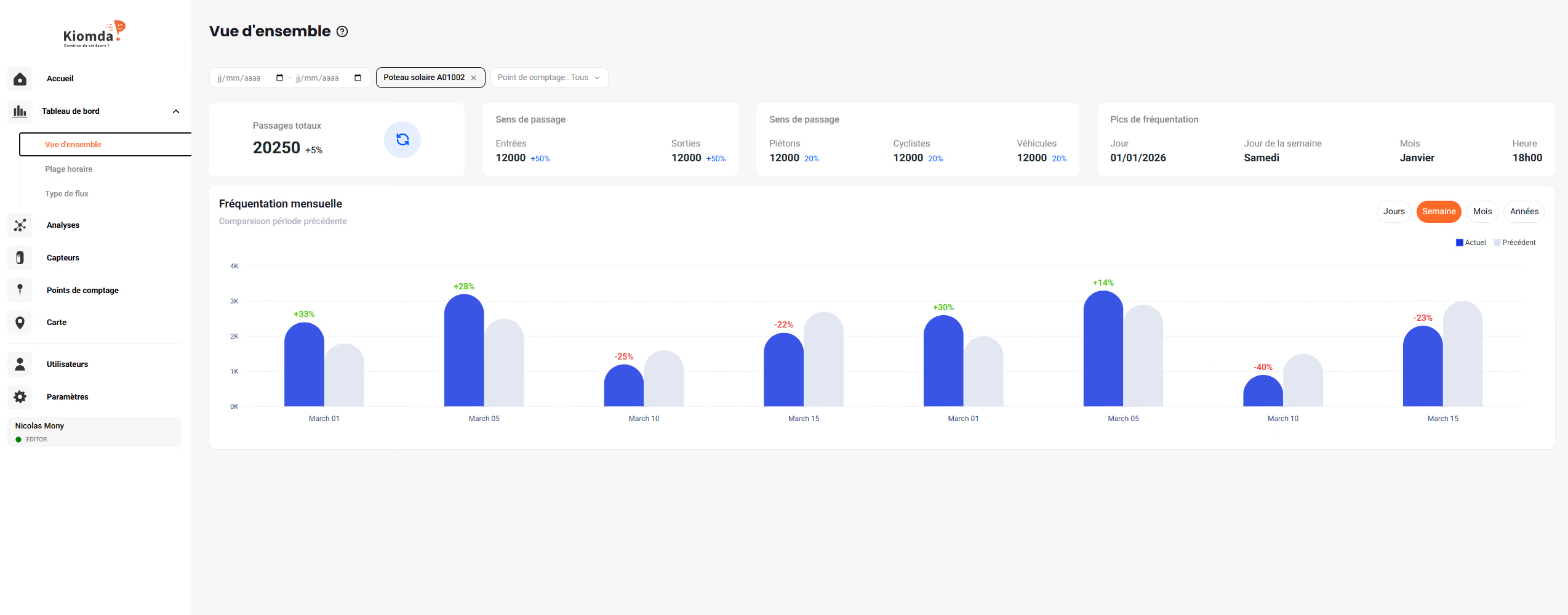
The Kiomda Report platform displays hourly charts, daily totals, and seasonal comparisons from any browser.


The standard casing is weather-resistant and designed for outdoor use. Its sleek and discreet shape blends naturally into urban and natural environments.


A reinforced, vandal-proof casing, perfectly suited for areas with high public traffic. This model is designed to withstand all types of damage.

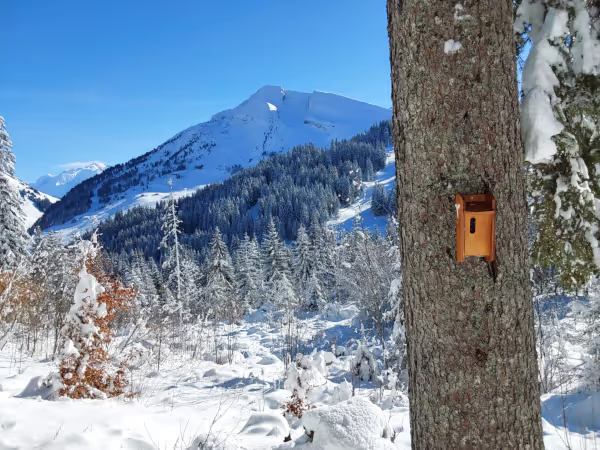
A birdhouse that blends into natural environments – ideal for nature reserves, parks, and protected areas.


A wooden post that completely conceals the sensor — ideal for greenways, rural paths, and heritage sites where visual impact must be minimal.

For structured layouts and high-traffic routes, Spirilo uses buried electromagnetic loop technology integrated directly into the road surface. Each passage creates a disturbance in the electromagnetic field, which the system analyzes to provide reliable counts, even in heavy traffic.
Unlike above-ground sensors, this approach allows for measurement without occlusion: users can follow each other closely without compromising data quality. The specific geometry of the loop also enables more detailed analysis of passages, with the ability to distinguish between user types—such as bicycles, scooters, or motor vehicles, depending on the configuration—based on their electromagnetic signature.

Electromagnetic detection provides stable measurements, independent of external conditions (light, weather, ambient temperature).
The loops are directly integrated into the road surface, with no visual impact or surface installation constraints.
No electrical connection required, runs on a long-life battery.

The system can be connected to existing loops, allowing for the modernization of a setup without extensive intervention.
The electromagnetic signature makes it possible to qualify flows and distinguish between different types of users.

Two consecutive loops determine the direction of travel. Suitable for local roads, access routes, or alternating one-way traffic.

A pair of loops counts passages and can distinguish between vehicle types based on their electromagnetic signature.

One loop per lane for independent counting in each direction. Suitable for zone entrances, roundabouts, or high-traffic transit routes.

Case Studies

Each site is different — we help you choose the easiest and most reliable configuration.


Absolutely not. Unlike traditional meters (magnetic loops in the road or pneumatic tubes), our Verdilo sensor is installed without any civil engineering or electrical connection. It can be attached to an existing post, wall or candelabra in a few minutes.
No, our technology is guaranteed to be 100% video-free. The Verdilo sensor uses thermal detection (for hot flows) coupled with magnetic detection (metal mass). The data collected is therefore completely anonymous from the moment it is captured, which eliminates any complexity associated with the GDPR.
Yes. In mixed channel configurations (width less than 6 meters), the combination of our thermal and magnetic sensors makes it possible to isolate metal masses from simple heat flows. We can thus distinguish a vehicle from a bicycle or a pedestrian to offer you refined mobility data.
No. Our approach is to provide simple, reliable volume data useful for managing and developing your public spaces. Verdilo does not make a detailed classification by type of vehicle (truck vs car) and does not record speeds per km/h. It is a mobility analysis tool, not a traffic control tool.
To maintain battery life of up to 2 years (or unlimited autonomy with the solar version), the sensor does not transmit data continuously. Data is sent automatically and securely to your Reports dashboard every 12 hours — sufficient for analysing traffic patterns, seasonal trends and daily usage
Our sensors, by default, transmit data every 12 hours. This frequency can be set on request. However, if the transmission frequency is increased, this will have consequences on the autonomy of the meter. In fact, we also have a manual data recovery solution for sites that do not have a connection, guaranteeing reliable data tracking, even in isolated locations or without a network.




.svg)




.avif)