

English


In public spaces as well as in sites open to the public, the question of attendance has become central. How many people are taking a path, crossing a square, or accessing a site at any given time? Behind these apparently simple questions, there are very concrete issues of planning, security, maintenance or even the management of public policies. The pedestrian crossing counter has established itself as a reference tool to meet these needs, provided it is well understood and properly used.

One Pedestrian Crossing Counter Allows you to Automatically Measure the Number of People Crossing a Given Point, without human intervention and over long periods of time. It provides objective data on the actual attendance of a place, where visual or ad hoc estimates quickly show their limits.
In particular, this data makes it possible to understand the rates of use of a site. They highlight peak hours, off-peak periods, differences between week and weekend or even seasonal variations. They are also valuable for measuring the impact of an event, work or new layout.
In a logic of monitoring over time, the pedestrian crossing counter becomes a Continuous observation tool, at the service of decision-making.
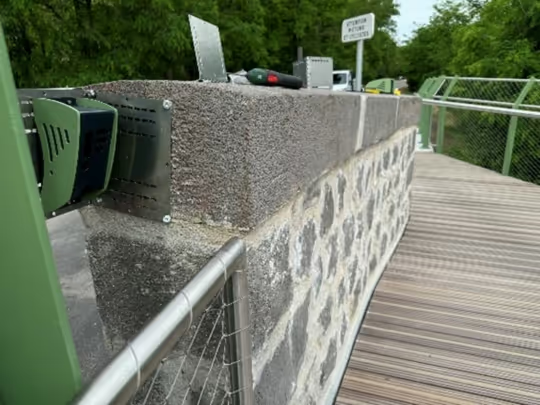
The principle is simple: the meter is installed at a strategic location, often a restricted passage or a clearly identified path, and detects each pedestrian crossing.
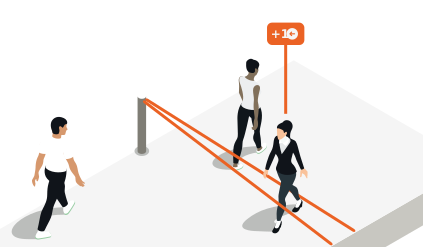
Depending on the technology used, this detection may be based on various technical principles. Some devices use infrared beams, others use radar technology, or combinations of sensors. The objective remains the same: Count a Pass, without Trying to Find Out Who the Person Is.
It is important to distinguish here the term from Counter Of that of Sensor. The pedestrian crossing counter refers to the tool as a whole, while the sensor corresponds to the technical principle of detection. This distinction makes it possible to better understand the issues without entering unnecessarily into overly technical considerations.
Our page dedicated to counting pedestrians
One of the Essential Points of the Pedestrian Crossing Counter is its Respect for privacy. Contrary to popular belief, it is not a surveillance tool. A well-designed counter does not recognize faces, identities, or individual trajectories.
It simply counts passages, in an aggregated manner. No personal data is collected, stored or used. This approach guarantees not only regulatory compliance, but also the acceptability of the device in the public space.
For communities and site managers, this is a decisive point. It allows the installation of permanent measurement devices, without generating distrust on the part of users.
The choice of location is a key factor in data quality. A pedestrian crossing counter must be positioned where the flow is legitimate and coherent: park entrance, main path, access to a site, connection between two spaces.
Poor positioning can lead to incomplete or biased counts. On the other hand, a well-thought-out implementation makes it possible to produce reliable, comparable data over time and truly usable.
This is why the deployment of a meter should not be considered only as a technical installation, but as a Observation process, integrated into the operation of the site.
The pedestrian crossing counter is used in many contexts. In urban areas, it helps to understand flows in the city center, in pedestrian areas or around public facilities. In natural or tourist areas, it makes it possible to measure attendance without degrading sites or disrupting uses.
It is also used in more specific contexts, for example to assess the impact of an event or a development experiment. In these cases, it provides objective data where impressions or statements remain insufficient.
A pedestrian crossing counter is only valuable if the data it produces is used. Isolated, they remain numbers. Analyzed over time, cross-referenced with other information and put into context, they become a real Decision Support Tool.
They make it possible to prioritize interventions, to justify choices, to anticipate developments or to dialogue more calmly with partners and elected officials. In this perspective, the meter is not an end in itself, but the starting point for a broader reflection on the uses and needs of the territory.
The pedestrian crossing counter may seem simple in principle. However, its relevance depends heavily on its suitability with the site, the objectives pursued and the constraints of the field. Autonomy, robustness, discretion, data continuity: all criteria that determine the reliability of the measurement.
Well used, it is a valuable tool for better understanding pedestrian uses and acting in an informed manner, without excessive intrusion or complexity.
For a more global vision, discover our article:
Passage counter: understand, measure and decide based on flows



.jpg)


.svg)