1. Non-intrusive, off-camera solutions adapted to public transport environments
The referenced Kiomda solutions are exclusively off-camera, non-intrusive, and installed above ground — a fundamental technical characteristic that meets the growing requirements for social acceptability and data protection in public transport spaces.
Stereoscopic thermal counting: accuracy and native GDPR compliance
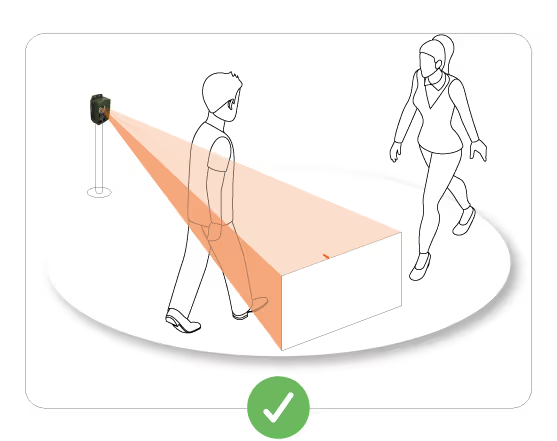
Kiomda stereoscopic thermal sensors produce no images, identifiers, and personal data. They detect the thermal signatures of bodies in motion and count the passages completely anonymously.
Benefits of this approach:
- Native RGPD compliance: no processing of personal data, no CNIL declaration, no obligation to inform users
- Maximum social acceptability: no perception of surveillance, absence of film devices
- Operational simplicity: no secure storage of video streams, no complex software maintenance
Stereoscopic technology: multi-flow pedestrian/cyclist classification
The dual stereoscopic sensor analyzes the scene in three dimensions, allowing the height, width, and speed of the detected subject to be measured with high precision.
Classification performance:
- Overall counting accuracy: 95 to 98% under normal conditions
- Pedestrian/cyclist classification accuracy: 90 to 95%
- Day and night operation, independent of light conditions
- Robust in bad weather (rain, fog)
This ability to distinguish between pedestrians and cyclists is particularly relevant for:
- Dimensioning waiting and circulation areas in interchange centers
- Evaluate cycling policies to train stations
- Measuring pedestrian flows on access paths to stations
- Documenting intermodality projects
2. Above-ground installation: autonomy and flexibility of deployment
Above-ground installation (sensors fixed to existing masts, posts or supports) offers several decisive operational advantages:
Fast deployment
- No civil engineering work
- No trenches or excavations
- Installation in a few hours
- Immediate commissioning
Energy autonomy
- Long-lasting battery operation
- Charging by integrated solar panel
- No electrical connection required
- Adapted to sites without electrical infrastructure
Reversibility and adaptability
- Sensors can be repositioned without leaving traces
- Possibility to install on temporary sites (construction sites, events)
- Easy adaptation to changes in terrain configuration
3. Field-proven solutions
Kiomda sensors have been deployed for several years on various sites: greenways, natural areas, city centers, urban and peri-urban cycle paths. This field experience has made it possible to develop specific expertise on public transport environments.
Typical use cases:
- Measuring pedestrian traffic around interchanges and train stations
- Quantification of cycling uses on the drawbacks to the stations
- Monitoring the evolution of flows as part of mobility plans and infrastructure transformations
- Assessment of the impact of developments promoting active mobility
- Production of objective data for funding applications (calls for mobility projects, CRTE, regional programmes)
Environmental robustness
- IP67 certification (total watertightness)
- Operating temperature range: -20 to +60°C
- Resistant to UV, frost, and thermal variations
- Adapted to dense urban environments as well as exposed sites
4. A complete offer: equipment, services, maintenance
The CATP framework agreement covers the entire value chain: acquisition of equipment, ancillary services, operation and maintenance.
Acquisition of meters
- Non-intrusive pedestrian counters
- Mixed bicycle/pedestrian counters above ground
- Configurations adapted to different types of sites (high density, rural areas, exchange centers)
Services
- Support for the installation and positioning of sensors
- Technical team training
- Data validation during the first weeks of operation
- Technical support and remote assistance
Maintenance and operation
- Preventive and corrective maintenance contracts
- Replacing batteries and components
- Software update and recalibration if required
- On-site interventions in case of malfunction
This global approach guarantees the reliability and durability of the device over its entire lifespan (5 to 10 years).
5. Data visualization and exploitation platform
The data collected by Kiomda sensors is accessible via an intuitive web platform, designed for technical teams and decision makers.
Main features:
- Real-time or historical visualization
- Attendance charts (day, week, month, year)
- Distinction between pedestrians and cyclists on mixed sensors
- Data export in standard formats (CSV, Excel, API)
- Comparison between several measurement points
- Alerts in case of sensor malfunction
Hosting and data sovereignty:
- Data hosted in France
- RGPD compliance guaranteed
- Secure access by identifiers
- Retention of data over several years for evolution analysis
6. A strategic step for Kiomda
This CATP listing marks several structuring advances:
Institutional recognition. The CATP selection process is based on strict criteria of technical compliance, financial strength, production capacity and service quality. The referencing validates the robustness of the Kiomda offer.
An integration into the public transport ecosystem. Kiomda joins the circle of suppliers referenced for major players in French public transport, in addition to its existing deployments on greenways, natural areas and city centers.
An expansion of the scope of intervention. Beyond greenways and natural areas, Kiomda extends its expertise to public transport environments: interchange centers, stations, parking and relay, pedestrian and bicycle paths connected to transport networks.