

English


Wi-Fi tracking is often presented as a simple solution for measuring the use of public spaces: smartphones emit signals, all you have to do is count them. In reality, the implementation is more complex. It requires the installation of dedicated equipment and raises specific regulatory issues. Faced with this approach, autonomous thermal sensors propose a different logic, based on the physical detection of passages. This comparison analyzes in detail the technical, operational and regulatory differences between Wi-Fi tracking and autonomous sensors for pedestrian counting.

To go further, consult the technical and regulatory documentation:
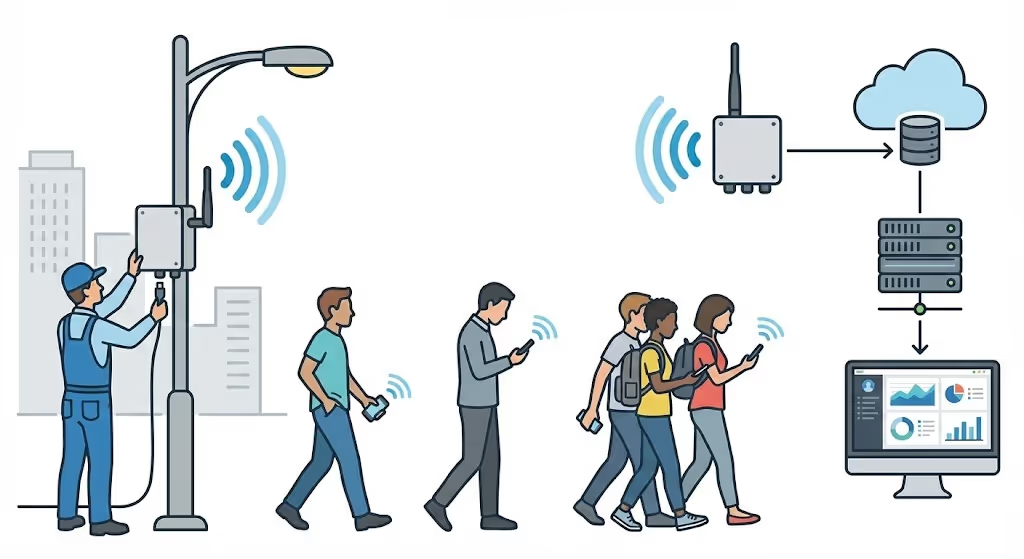
Wi-Fi tracking is based on the detection of signals emitted by smartphones and connected objects. These devices regularly broadcast technical identifiers via Wi-Fi or Bluetooth, which terminals can pick up nearby.
One point is often misunderstood: it is not a question of using the 4G or 5G antennas of telecom operators.
Mobile antenna data belongs to operators and is highly aggregated. They cannot be directly used to count the number of passages at the entrance of a park or a public square.
In the case of Wi-Fi tracking in public areas, it is necessary to install dedicated boxes on site. These terminals:
Without this physical equipment, no data is collected.
This infrastructure generally involves:
Wi-Fi tracking is therefore not an “intangible” solution. It is based on an active installation, comparable to a network of radio sensors.

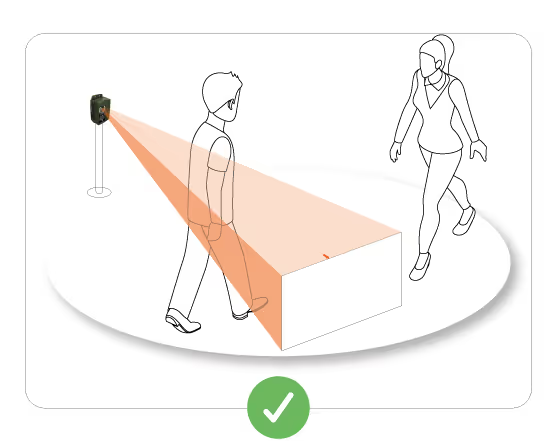
The autonomous thermal sensor takes a different approach. It doesn't pick up any digital signals and doesn't interact with any personal devices.
It detects the presence and movement of a body thanks to its thermal signature. In the case of a stereoscopic system, two sensors make it possible to identify the direction of passage and to limit errors.
The data produced corresponds to a real physical passage.
Unlike Wi-Fi tracking, this technology:
An autonomous sensor works on a long battery life, with low speed transmission or delayed synchronization.
The installation logic is lighter and reversible.
The central question for a community is not only “how much data”, but “how robust over time”.
With Wi-Fi tracking, measured attendance depends on the level of user equipment and on technical parameters that are invisible to the operator. An evolution of a manufacturer's privacy policies can change the quality of the data without the public space having changed.
Actual attendance can remain stable while the volume of signals detected decreases.
The autonomous thermal sensor, on the other hand, remains independent of these external technological developments. The data produced is directly linked to the physical passage.
This does not mean that a thermal sensor is infallible. Its precision depends on the positioning, the configuration and the installation context. But its measurement principle remains stable over time.
For impact assessment projects — for example, measuring the evolution of the number of visitors to a square after redevelopment — temporal comparability is a decisive criterion.
The regulatory dimension has changed profoundly in recent years.
Wi-Fi tracking involves the collection of technical identifiers linked to individual devices. Even when these identifiers are pseudonymized or hashed, they can be considered personal data within the meaning of the GDPR, especially if they allow indirect re-identification.
This requires:
Compliance can become an operational and reputational challenge.
The autonomous thermal sensor, by not collecting any image or identifier, is based on anonymous measurement logic by design. It does not capture any data that could identify an individual or a device.
For local authorities, this difference often weighs heavily on the decision, especially in sensitive or tourist areas.
The installation environment strongly changes the relevance of solutions.
Wi-Fi tracking requires an infrastructure of interconnected sensors, a stable power supply, and regular maintenance. In a dense city center, these conditions can be met.
In a natural environment, on a remote greenway or in a park without network coverage, implementation becomes more complex. The lack of infrastructure limits the reliability of the system.
The autonomous thermal sensor, powered by battery and transmissible at low speed, is more easily adapted to these contexts. It can work without an electrical connection and without a local Wi-Fi network.
The question then becomes strategic: do we want to measure a dense urban space or a diffuse territory?
It would be simplistic to oppose the two technologies head-on.
Wi-Fi tracking can be useful when the objective is to analyze global flows in an already equipped environment, with a broad statistical monitoring logic.
The autonomous thermal sensor is particularly suitable when the objective is to produce a reliable, stable and comparable measurement over time, in particular for:
The choice therefore depends less on the effect of technological modernity than on the actual use expected.
Wi-Fi tracking and the autonomous thermal sensor do not respond to the same measurement logic.
The first detects digital signals dependent on individual equipment and requires a dedicated infrastructure on site.
The second measures a physical passage, without interaction with user devices and without dependence on a local electrical infrastructure.
In a territorial project, robustness, comparability and simplicity of installation are often more structuring than technological sophistication.



.jpg)

.svg)





.avif)