

English


Measuring attendance has become a strategic tool to justify public developments and funding. However, when choosing a technology, confusion often persists between video systems (cameras) and thermal sensors. This article deciphers the fundamental differences between these two approaches: GDPR impact, hidden installation costs and real reliability in the field, to help you arbitrate objectively.

Measuring the number of visitors to public spaces, natural parks or event sites has become a strategic issue for many local authorities and land managers. Knowing the number of passers-by, visitors or cyclists makes it possible to justify investments, to assess the impact of a development, to optimize the management of flows or to build a grant application file.
Two families of technologies are most often in competition during calls for tenders or budget arbitrations:
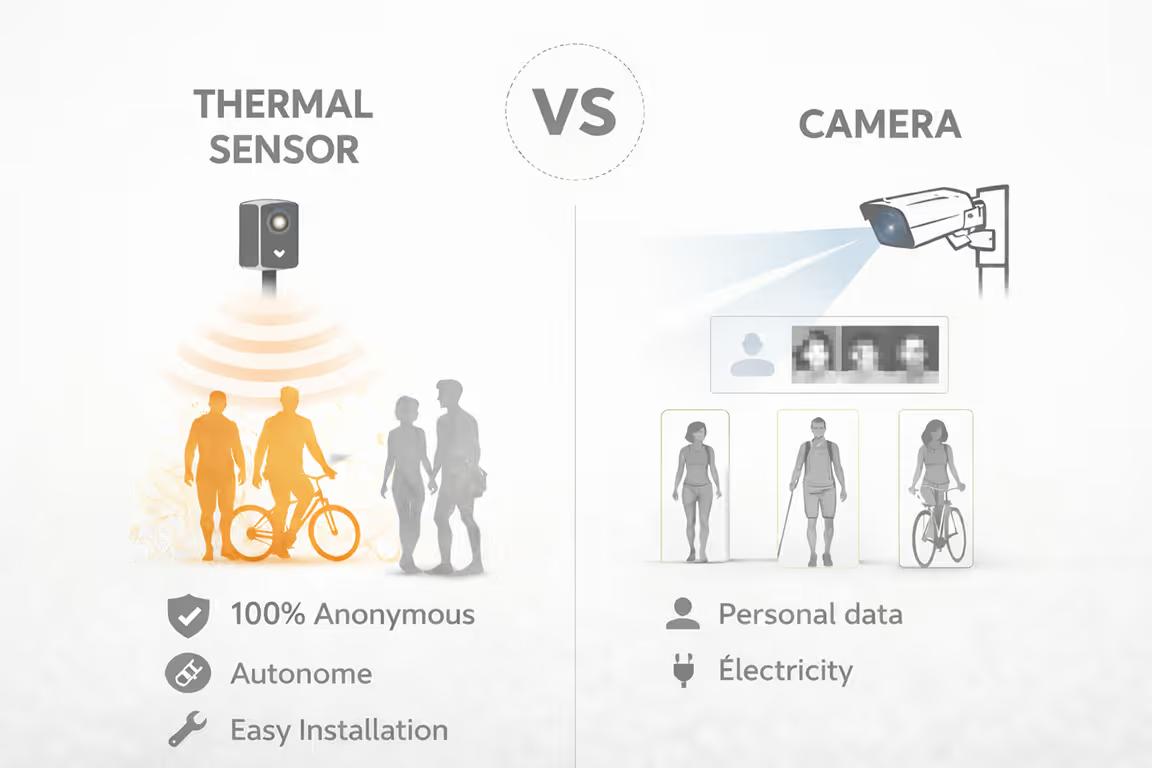
Confusion between these two approaches is common, in part because the word “thermal” covers very different realities: a thermal camera produces an infrared image of an individual, while a stereoscopic thermal sensor detects a variation in heat in a field of view without ever producing an image. This distinction is fundamental, both technically and legally.
Camera counting systems rely on the analysis of a video stream or images. Whether they are conventional cameras coupled with a silhouette detection algorithm, thermal cameras producing infrared images, or AI vision solutions, the principle is the same: a visual flow is captured, then processed to extract counting data.
Depending on their level of sophistication, these systems can distinguish categories of users (pedestrians, cyclists, strollers), analyze behaviors, measure residence times or generate heat maps. They offer greater information density and can meet detailed analysis needs, especially in commercial or security contexts.
The other side of the coin: This analytical wealth has a counterpart. Even unintentionally, the camera captures visually identifying elements. Even without explicitly activated facial recognition, a video image of a person in a public space constitutes personal data within the meaning of General Data Protection Regulation (GDPR). This involves specific obligations: information to individuals, justification of the legal basis, limited retention periods, appointment of a data controller, and often a Data Protection Impact Assessment (DIPD).
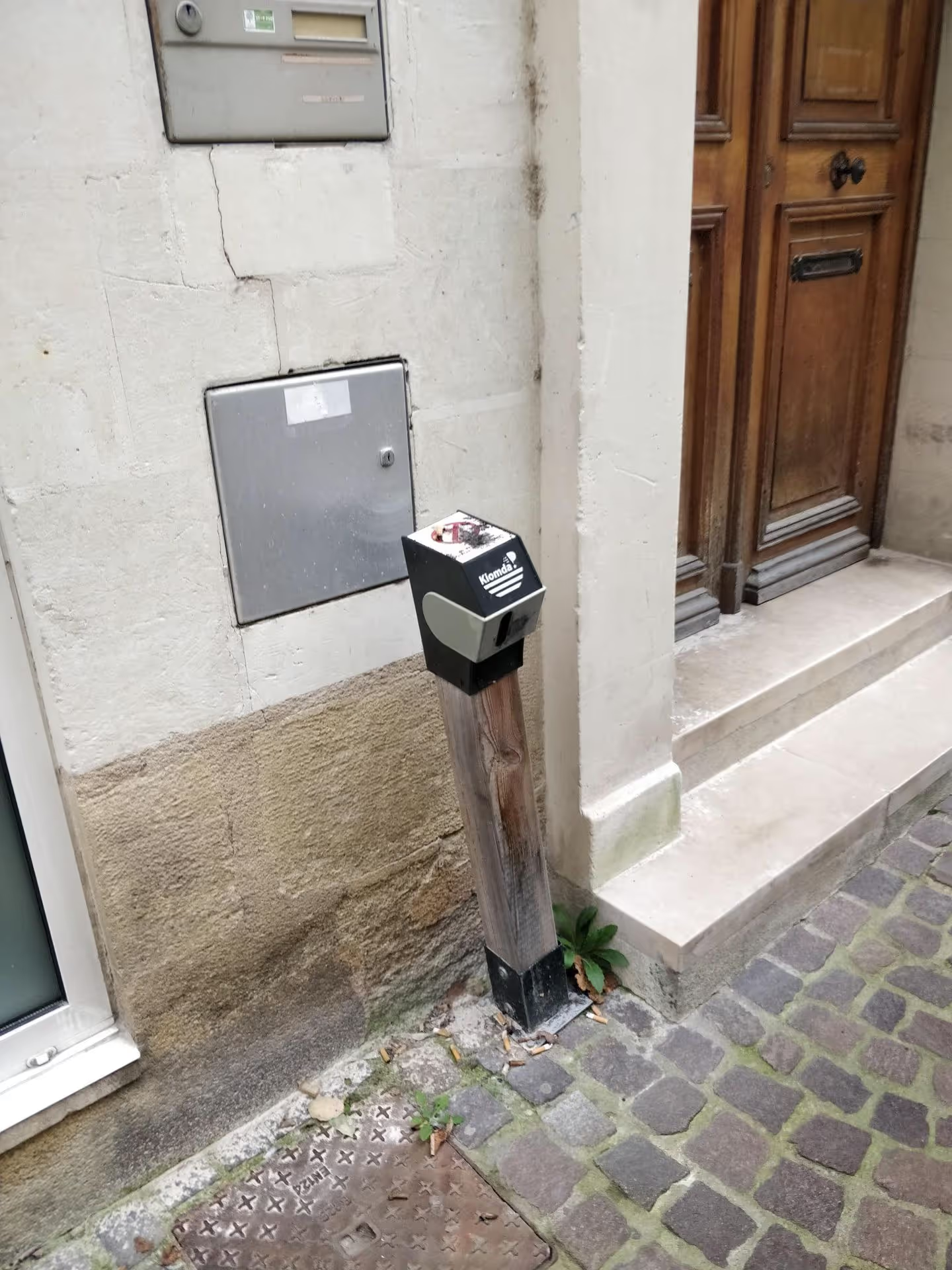
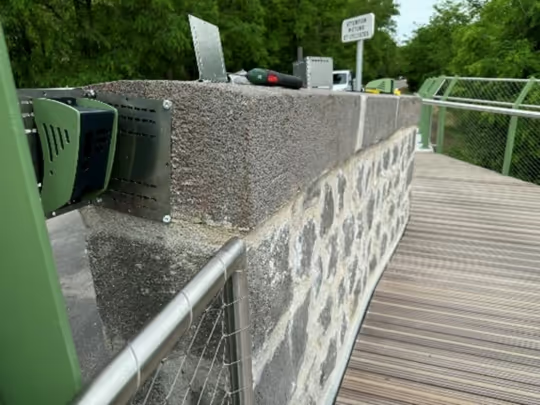
A stereoscopic thermal counting sensor operates on a radically different principle. It detects the variations in infrared radiation emitted by human bodies in its field of detection, without producing any images. Stereoscopic technology makes it possible to distinguish directional flows (entrance/exit), to separate several nearby users, and in the most advanced versions, to differentiate categories of users (pedestrians vs cyclists) according to their thermal signature and their speed of movement.
The result: Robust, directional and categorized counting, without any visual or biometric data ever being captured. The person detected is only an anonymous thermal signal. This architecture guarantees native RGPD compliance (Privacy by Design), without the need to implement pseudonymization measures, algorithmic blurs, or processes for the periodic removal of images.
For local authorities, this characteristic is decisive: the installation of a thermal sensor does not require specific deliberation by the city council on the processing of personal data, or registration with the CNIL for the processing of sensitive data.
The regulatory issue is probably the most underestimated factor in comparing counting solutions. Since the entry into force of the RGPD in 2018, and even more so since the CNIL guidelines on intelligent video surveillance published between 2020 and 2023, the constraints on camera-based systems have increased considerably.
In France, the installation of a video protection system in a public space is subject to prefectural authorization. Even when the system has no security purpose but only analytical purposes, the capture of images of identifiable persons triggers the obligations of the RGPD. The CNIL also recalled that anonymization must be irreversible to fall outside the scope of application of the regulation, which excludes most blur systems a posteriori.
Beyond the legal framework, the social acceptability of video surveillance in public spaces is in growing question. In natural parks, on greenways or in city centers, the presence of cameras regularly generates negative reactions from users and local associations. This reputational risk is rarely integrated into total cost of ownership calculations for a camera solution.
Non-imaging thermal sensors escape this problem by design. They are not subject to any specific video protection obligations, do not capture any images and do not process any personal data. Their installation in a public or natural space does not generate any particular regulatory constraints beyond ordinary physical location rules.
The purchase price of a camera system may seem comparable to, or even lower, than that of a standalone thermal sensor. But this comparison does not last over time if all cost items are integrated.
Over five years, the difference in total cost of ownership between the two approaches can be significant, especially for networks of multiple measurement points.
Natural spaces, greenways, temporary event sites or mountain stations share a common constraint: the absence or fragility of the electricity supply. In these contexts, a permanent camera solution involves major civil engineering work or the use of generators, which considerably increases its cost and environmental footprint.
La reversibility is another criterion that is often overlooked. A standalone thermal sensor can be moved, reinstalled at another site, loaned out or reused for an event. A wired camera installation is generally permanent, which limits the ability to adapt the measurement device to changes in uses or observation priorities.
Finally, for measurement networks comprising numerous points (regional cycle routes, hiking trails, tourist areas), the scalability of an autonomous solution without work is a decisive advantage. It makes it possible to quickly deploy several dozen sensors without coordination with road services or network dealerships.
Precision is often the business case for camera solutions. It is true that the most advanced AI vision systems achieve very high detection rates under controlled conditions. But accuracy in real conditions, in the field, is another matter.
The standalone stereoscopic thermal sensor is the preferred solution in the following situations:
The “camera vs thermal sensor” debate does not have a universal answer: it depends on the context of use.
For local authorities, managers of natural areas and event organizers who seek to measure flows in a reliable, anonymous and rapidly deployable, the autonomous stereoscopic thermal sensor offers a significantly higher value-stress ratio. It produces actionable data without the legal risks or civil engineering costs.
The camera, for its part, is relevant in contexts where detailed behavioral analysis is necessary, where safety is a priority, or the site has an adapted electrical infrastructure.
If you want to assess which solution is adapted to your territory or your project, Kiomda supports local authorities and space managers in diagnosing their needs to measure attendance.



.jpg)

.svg)