

English


Free, open-access car parks represent a management challenge that local authorities, tourist site managers and transport operators are well aware of. Unlike paid car parks equipped with barriers and access control systems, these open parking spaces do not have any natural device to count the vehicles entering, leaving or occupying the spaces. However, measuring their attendance has become essential: to size extensions, optimize seat rotation, pilot mobility policies or regulate tourist numbers. This article analyzes existing methods for counting vehicles in barrier-free car parks, compares their advantages and limitations, and proposes an operational framework for choosing the right solution for each context.

Open-access car parks occupy a central place in the organization of trips, but remain largely controlled blindly. City centers, natural sites, car parks and tourist areas, tourist areas: these parking spaces accommodate thousands of vehicles every day without managers having accurate data on their real use.
This lack of visibility poses concrete operational problems. Elected officials ask whether new places should be created, but there is no data on whether existing places are saturated or underused. Technical services must organize maintenance and surveillance without knowing the peak periods. Funders require numerical justifications for extension projects, but estimates are based on printings or occasional manual counts.
Saturation management. Car parks in city centers or tourist sites are experiencing peak traffic that generate queues, illegal parking on the side streets and a deterioration of the visitor experience. Knowing when and how often saturation occurs makes it possible to adapt the offer: targeted extension, time regulation, creation of relay car parks.
Optimization of rotation. At some sites, the problem is not the number of seats but their prolonged occupancy. A car park with 50 spaces occupied all day by the same vehicles generates less capacity than a car park with 30 spaces with a rotation of 3 vehicles per space per day. Measuring incoming/outgoing flow rather than static occupancy makes it possible to identify these situations.
Management of mobility policies. Mobility organizing authorities (AOM) must assess the efficiency of car parks and relays, measure the modal shift to public transport, and justify investments in parking infrastructure. This evaluation is only possible if attendance is objectified over time.
Measuring the number of visitors to an open car park is more complex than it seems. Three structural characteristics create specific methodological difficulties.
Most free car parks have multiple entrances and exits. A natural site car park can have four accesses from different roads. A linear car park along a lane can extend over several hundred meters with diffuse entrances. This configuration prohibits solutions that rely on a single point of passage.
Systems designed for closed car parks (automatic barriers, entrance/exit license plate cameras) are becoming inapplicable or would require a multiplication of sensors that is expensive and complex to synchronize.
In an open car park, vehicles do not follow predictable paths. They enter from any side, move freely between rows, and can leave through a different access than the one they entered. This fluidity makes it difficult to accurately identify entry/exit movements.
Some vehicles only cross the car park without parking (rollover, drop-off). Others park for a few minutes and then leave. Still others stay for several hours. Distinguishing these behaviors requires a more sophisticated detection logic than a simple counting of passages.
On some sites (roadsides, natural gravel car parks), the locations are not materialized. Vehicles park where they can, sometimes in double file, sometimes in areas not originally planned. The actual number of places therefore varies according to the spontaneous organization of users.
This configuration makes obsolete any approach based on the monitoring of individual places (presence sensors per place). You have to think in terms of flows and overall occupancy rather than in single places.
The choice of a counting method depends closely on the type of car park and the questions you want to answer.
Characteristics: 50 to 200 seats, several entrances, dense attendance during the day, objective of rapid turnover to promote trade.
Priority need: Measure the occupancy rate in real time to inform users (“available places” panels), identify the hours of saturation, assess the effectiveness of a time-limitation policy.
Key indicator: Instant occupancy rate (% of spaces occupied at the moment t) and average parking time.
Characteristics: Seasonal parking, high variability (desert during the week out of season, saturated during summer weekends), multiple accesses, sometimes extendable capacity (parking on lawn).
Priority need: Anticipate saturation to trigger regulatory measures (temporary closure, orientation to alternative sites), produce annual attendance data for financing applications.
Key indicator: Cumulative daily flow (number of vehicles entered) and peak occupancy (maximum number of vehicles present simultaneously).
Characteristics: Parking on a natural site, access by forest roads, objective of limiting automotive pressure on the ecosystem, need to justify investments (shuttles, developments).
Priority need: Measure the evolution of car traffic over time, compare the effect of regulatory measures (pricing, access restrictions), produce annual reports.
Key indicator: Number of vehicles per day and per season, annual change, correlation with regulatory policies.
Characteristics: Parking relay connected to a station or a public transport stop, the aim of encouraging the transfer of car → train/bus.
Priority need: Measure the number of users of the parking relay, evaluate the duration of parking (a few hours = occasional use, all day = commuting use), cross-check with transport traffic data.
Key indicator: Daily inflow, average parking time, occupancy rate at peak hours.
Principle: Magnetic detection loops are installed under the roadway at the entrances and exits of the car park. Each vehicle pass is recorded. The crossing of incoming and outgoing flows makes it possible to calculate occupancy in real time.
Implementation conditions: Requires civil engineering work (trenches, asphalt). Works well in car parks with ducted and few accesses (1 to 2 entrances maximum).
Advantages: High reliability (> 98% success rate for vehicle detection according to manufacturers), technology proven for decades, insensitive to weather conditions.
Concrete limits: High installation cost (road works), complex maintenance in case of deterioration of the road, unsuitable for car parks with multiple diffuse accesses. If a secondary access is not equipped, the data is falsified. The entry/exit logic assumes that each vehicle that enters eventually exits, which is a problem in case of very long parking (several days).
Verdict: Relevant solution for structuring car parks with one or two well-defined accesses, but unsuitable for multi-access open car parks or with diffuse configurations.
Principle: Cameras installed at the entrances and exits of the car park automatically read license plates. The system associates each entry with an exit, making it possible to calculate the occupancy in real time and the duration of parking per vehicle.
Implementation conditions: Installation of cameras at all accesses, electrical connection or solar power supply, image processing server, CNIL declaration, user information (panels).
Advantages: Very precise data (unique identification of each vehicle), possibility of calculating individual parking times, detection of recurrences (suction vehicles).
Concrete limits: Heavy GDPR constraints (license plates are personal data according to the CNIL), need to justify the purpose of the processing, limited data storage period, right of access and correction to be managed. In 2017, the CNIL published specific recommendations on the use of the LAPI to control paid parking and put several municipalities on notice in 2020 for non-compliant use. High installation and maintenance cost. Sensitivity to lighting conditions (night, backlight) and to dirty or non-compliant plates. Variable social acceptability (perception of surveillance).
Verdict: Technically efficient but legally complex solution. Reserved for paid car parks where license plate control is justified by billing, or for car parks where a maximum duration regulation authorizes treatment. Not very suitable for free car parks in natural or tourist sites where surveillance is perceived negatively.
Principle: Terminals pick up Wi-Fi or Bluetooth signals emitted by smartphones in vehicles. Each detected device is anonymized via a cryptographic hash. The system counts the number of unique devices within the car park perimeter.
Implementation conditions: Installation of terminals at each access point or at several points in the car park, electrical or solar power supply, treatment server.
Advantages: Rapid deployment (no civil engineering work), native anonymization (facilitated GDPR compliance), possibility of tracking the duration of presence.
Concrete limits: Variable detection rate (30 to 70% of vehicles depending on the Wi-Fi/Bluetooth activation of smartphones). A vehicle with several passengers can generate multiple detections. A vehicle without a smartphone is not detected. The results must be corrected by a multiplying factor, which introduces a margin of error. Sensitivity to radio interference in dense urban areas.
Verdict: Solution suitable for trend studies and time comparisons (evolution of attendance), but inaccurate for absolute counting. Useful for measuring orders of magnitude and dynamics, less for displaying a reliable real-time occupancy rate.
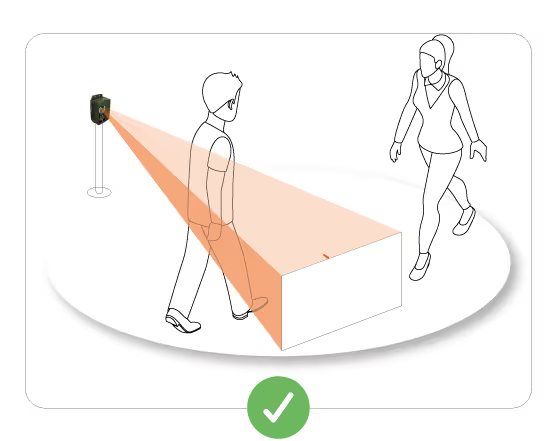
Principle: Thermal (infrared) or radar sensors are installed high up (masts, existing posts) and detect vehicles passing in their field of vision. Each pass is recorded, allowing entries and exits to be counted.
Implementation conditions: Installation of masts or fixing to existing supports, battery and solar panel power supply (no electrical connection required), configuration of the detection field.
Advantages: Fast deployment (a few hours per sensor), no civil engineering work, no personal data collected (native GDPR compliance), energy autonomy, insensitivity to lighting conditions (works at night), possibility of covering several traffic lanes with a single sensor.
Concrete limits: Accuracy depends on the height and the angle of installation (initial calibration required). Sensors count passages, not parked vehicles: input/output logic is needed to calculate occupancy. In car parks with multiple unequipped accesses, vehicles may evade counting. Requires strategic positioning to capture all flows.
Verdict: Solution adapted to car parks with identifiable accesses (even if they are multiple), easy to deploy and reposition, ideal for evolving configurations or temporary measures. Less suitable for fully distributed car parks without a ducted crossing point.
Principle: Agents or service providers manually count the vehicles present in the car park at regular intervals (every hour, or continuously for a day). User surveys complete the understanding of practices.
Implementation conditions: Mobilization of agents for several days, standardized counting protocol, processing of collected data.
Advantages: Total flexibility (adaptation to all configurations), possibility of capturing qualitative information (type of vehicle, behavior, origin/destination).
Concrete limits: High human cost (several agent days per site), non-reproducibility (inter-observer variability, fatigue), impossibility of continuous measurement over several months. The data is punctual and does not allow seasonal or weekly variations to be captured. Observer effect (the presence of someone who matters can change behavior).
Verdict: Relevant solution for one-off studies, automatic device validations, or initial diagnoses. Unsuitable for long-term management or for the production of continuous data.
A common confusion in car park counting projects concerns the difference between Measuring occupancy and measure flows.
The occupancy rate answers the question: How many seats are occupied at the moment? It is a static indicator, useful for real-time information (“X places available” panels) or to identify moments of saturation.
Appropriate methods: Cameras with counting the number of vehicles present, presence sensors per place (if places are present), regular manual counts. For entry/exit systems (loops, above ground sensors), the occupancy rate is calculated indirectly: vehicles present = accumulated entries - accumulated exits.
Limit: The occupancy rate says nothing about rotation. A car park with 80% occupancy all day with the same vehicles has a very different use than a car park with 80% occupancy all day long with the same vehicles being completely renewed every two hours.
The flow measures the Number of vehicles entering and leaving over a given period of time (hour, day, week). It is a dynamic indicator, useful for evaluating overall attendance, calculating average parking time, and sizing infrastructures.
Appropriate methods: All systems that detect passages (loops, LPR cameras, above ground sensors). The input/output logic makes it possible to reconstitute the flows.
Limit: The flow alone does not allow you to know if the car park is saturated at a given moment. A car park can register 500 vehicles during the day while remaining at 30% of average occupancy if the rotation is fast.
If the objective is to inform users in real time (dynamic panels), the occupancy rate must be measured.
If the objective is to assess annual attendance (balance sheets, financing files), flows must be measured.
If the objective is to optimize management (identify off-peak hours, assess rotation), the two indicators must be combined.
In a multi-access car park, it is rarely necessary to equip all the entrances. A preliminary analysis (field observation for a few days) makes it possible to identify the accesses that concentrate 80-90% of traffic. Equipping these priority accesses gives a reliable estimate of overall attendance.
Concrete example: A tourist site car park has four entrances. Two main accesses from the departmental road concentrate 85% of the flow. Secondary access from a forest road represents 12%. A last access, which is rarely used, represents 3%. Equipping the two main entrances is sufficient to obtain a representative measurement. The missing flow (15%) can be extrapolated or considered to be negligible depending on the desired precision.
For input/output logic to work, sensors need to detect vehicles before they enter the parking zone. A sensor placed in the middle of the car park will detect internal movements (traffic between rows, repositioning) without being able to distinguish between entrances and exits.
Recommended configuration: Sensor positioned on the access road, 20-50 meters before the first parking space. Detection field oriented to capture both directions of traffic (entry and exit). If the access road is bidirectional, a single sensor may suffice with processing logic that distinguishes the direction of traffic.
No automatic counting system works perfectly from the moment of installation. A calibration phase is essential: adjust the height, the angle, the sensitivity of the sensors, check that the passages are well detected, identify false positives (pedestrians, cyclists, animals).
Validation method: Compare automatic data with manual reference counts for 2-3 days. If the discrepancy is less than 5%, the system is reliable. If the difference is 5-10%, recalibrate and test again. Beyond a 10% difference, review the positioning or the technology chosen.
There are several common situations that distort data if they are not anticipated.
Very long term parking. A vehicle that remains parked for several days (motorhome, abandoned vehicle) continues to be counted as “present” in the entry/exit logic. If the system does not detect the exit (vehicle exited during a sensor failure, or exited through an unequipped access), the calculated occupancy drifts. Solution: Periodic reset (manual check count once a week) or long presence detection logic (alert if a vehicle stays >3 days).
Multiple crossings without parking. Some vehicles enter the car park, turn around and leave immediately (destination error, rollover zone). They are counted as one entrance and one exit, but did not actually use the parking lot. Solution: Temporal filtering (ignore input/output cycles of less than 2 minutes).
Convoys and groups. Several vehicles entering simultaneously (buses, convoys) can be detected as a single pass if the sensor does not distinguish successive vehicles. Solution: Sensitivity calibration to detect close passages, or punctual manual counting to correct busy days.
The Communauté d'Agglomération du Niortais is committed to an experimental process to better understand the uses of a parking relay and to qualify the logic of retraction to public transport.
Background: Parking relay with free access, without access control. Objective: to test the hypothesis of commuting (arrival in the morning, departure in the evening) and identify peak times to adapt the transport offer.
Solution selected: Installation of a Kiomda vehicle counting sensor in January 2025. Device equipped with an anti-vandalism cover, autonomous power supply, data transmission to the consultation interface.
Results and lessons learned:
Community testimony: “The idea was to test flexible and flexible counting systems. I look at the number of people using the car park, especially the arrival times, to see if it is used as a relay car park.”
Issue identified: The community highlights the need for simple and rapidly usable indicators. “We have more and more mobility data and few human resources to process them. You need to be able to quickly access simple and usable data [...] The idea is not to have dozens of ratios, but 5 or 6 indicators that are easy to read and use.”
Overall assessment: Quality of exchanges with the service provider, efficiency of vehicle counting, simplicity of the field device appreciated. Areas of improvement identified on the visualization interface and data exploitation.
The SIVOM du Born manages the collection and treatment of waste for 13 municipalities and 58,135 permanent users (72,399 with second homes). The Biscarrosse recycling center, with free access without entry control, required reliable counting to size the workforce and monitor flows.
Background: Lack of access control, historical manual counting by agents (pocket counter), risks of omissions and errors, need for consolidated data to justify human resources.
Solution selected: Installation of Kiomda counting boxes at the entrance to the recycling center. Anti-vandalism protection cover, autonomous power supply, access to daily consultation interface.
Operational results:
Data uses:
Vandalism issue: “I was afraid of vandalism because the box is at the entrance and the user is not identified. In the end, everything is fine, he is well protected.”
Overall assessment: Recommendation note 8-9/10. Solution appreciated for its precision, reliability and usefulness in the management of staff and flows.
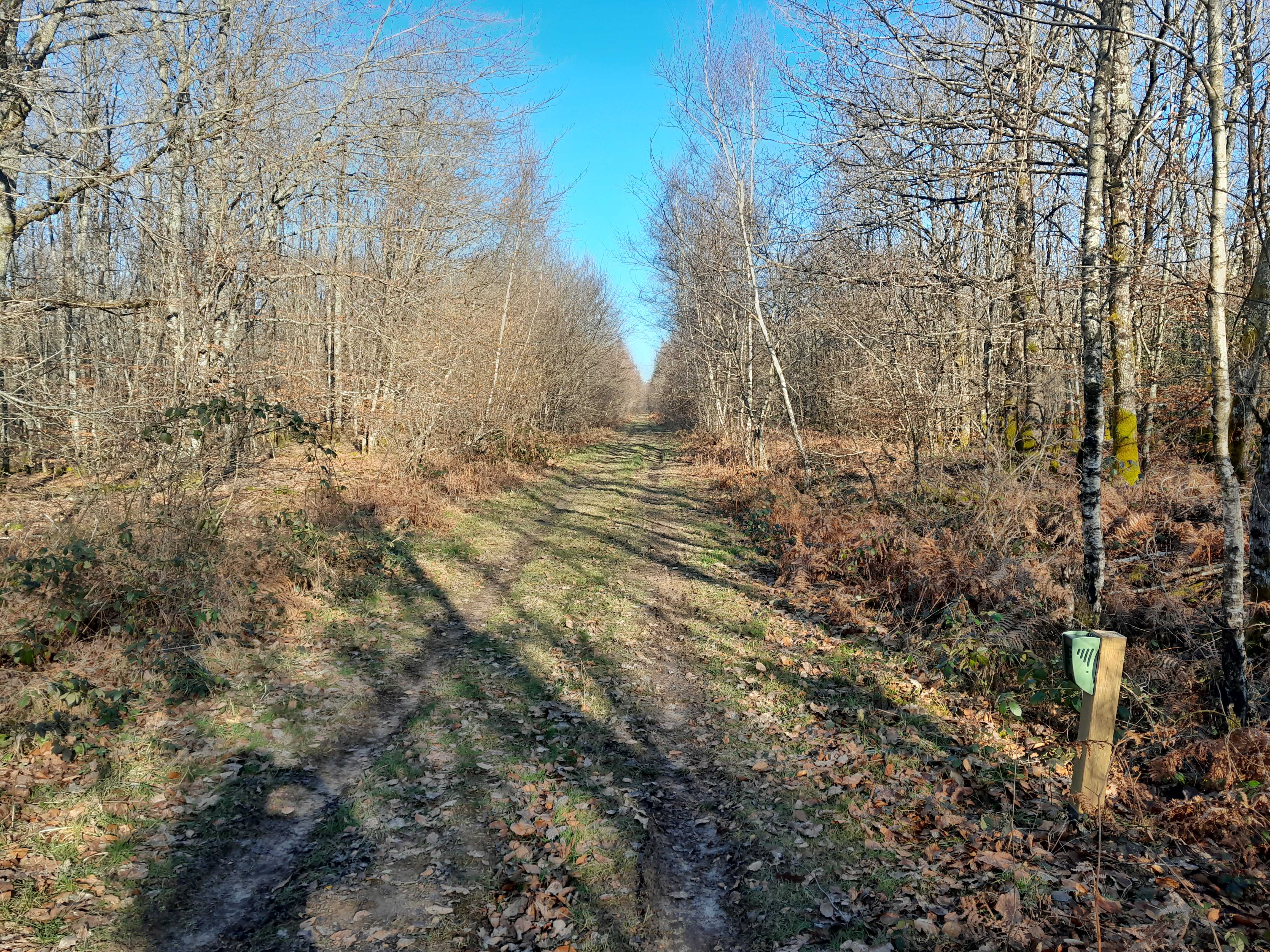
A protected natural site has a linear car park along a forest road, with free parking on the side. No physical places, capacity varies according to the spontaneous organization of users.
Solution selected: Installation of a thermal sensor at the entrance to the authorized parking area. The sensor counts the vehicles entering and leaving, but does not measure the instantaneous occupancy (impossible without defined seats).
Result after 12 months: Annual attendance of 28,000 vehicles, with a peak of 250 vehicles/day in August and a low of 15 vehicles/day in January. This data made it possible to size a summer shuttle from the neighboring town, reducing car pressure by 30% in July-August.
Teaching: This type of configuration illustrates the difficulty of measuring instantaneous occupancy (no fixed places), but the relevance of counting flows for seasonal management and the regulation of tourist arrivals.
Beyond the immediate operational challenge, measuring the number of visitors to open car parks is part of a wider transformation of territorial management practices. Local authorities are moving from a logic of supply (“creating places”) to a logic of management (“optimizing the use of existing places”).
Park-and-ride parks, car-sharing parks and tourist site car parks connected to shuttles are modal shift tools. Their effectiveness is measured by their actual rate of use, not by their theoretical capacity. A relay car park with 100 spaces occupied by 30% on average is a failure, even if it is well located. Continuous measurement makes it possible to quickly identify malfunctions and to adjust (communication, pricing, shuttle frequency).
Public car park extension projects require heavy investments (land, works, maintenance). Justifying these investments to funders requires showing that the existing system is saturated and that demand justifies the extension. Attendance data is becoming the main argument for funding applications.
In protected natural sites, car pressure is an environmental issue. Measuring car park occupancy makes it possible to trigger regulatory measures (temporary closure, orientation to alternative sites, dynamic pricing) before saturation generates destructive illegal parking.
Example: A regional natural park equips its five main car parks with flow sensors. When cumulative attendance exceeds a critical threshold (1,500 vehicles/day), dynamic signs direct visitors to lesser-known secondary sites. Result after two seasons: 40% reduction in overuse of iconic sites, 120% increase in visits to alternative sites, visitor satisfaction up 25%.
There is no one-size-fits-all solution for counting vehicles in free, barrier-free car parks. The choice depends on the type of parking, the measurement objectives, the available budget and the technical constraints.
For structural car parks with ducted access (1 to 3 well-defined inputs), aboveground sensors or magnetic loops offer high reliability with controlled costs.
For diffuse multi-access car parks (natural sites, tourist areas), a sampling approach (equipping the main accesses) combined with extrapolations makes it possible to obtain reliable orders of magnitude without multiplying the number of sensors.
For car parks where GDPR compliance and social acceptability are issues, non-intrusive solutions (thermal sensors, radar) are preferable to license plate cameras.
For spot diagnoses or validations, manual counting remains relevant, provided it is supplemented by automatic measurements for long-term monitoring.
The main thing is to clearly define the objective before choosing the method: are we looking to inform in real time, to assess annual attendance, to optimize rotation, or to regulate saturation? The answer to this question naturally leads to the appropriate solution.
The technical and legal data cited in this article are based on the following sources:
Accuracy of counting technologies
RGPD and API legal framework
Sensing technologies
Methodological noteThe precision orders mentioned (> 98%, > 99%, 2-5%) come from the technical documentation of manufacturers and integrators of counting systems. Actual performance is closely dependent on deployment conditions, installation quality, and initial calibration. It is recommended to conduct a validation phase on site (comparison with manual counts) before any operational use of the data.





.svg)
.jpg)







.avif)