

English


Tourist overcrowding has become a major political issue. From the creeks of Marseille to the Mont-Blanc trails, from the historic centers of Venice or Dubrovnik to the beaches of Brittany, the diagnosis is the same everywhere: “There are too many people.” But behind this apparent evidence lies a much more complex reality. What does “too many people” mean exactly? Compared to what? Measured how? Overattendance is a term that is used massively in public debate, but rarely defined rigorously. This imprecision is a problem: it makes objective diagnosis difficult, complicates the definition of intervention thresholds and weakens regulatory policies. This article proposes a framework for thinking about overattendance no longer as a subjective impression, but as a measurable and controllable phenomenon.

The word “overcrowding” has established itself in the vocabulary of tourist site managers, local officials and the media. But it covers heterogeneous realities that it is essential to distinguish.
Overattendance refers to a situation where the use of a space exceeds a threshold beyond which negative effects appear. But this threshold is never absolute. It depends on several variables:
The physical capacity of the site. A narrow mountain trail cannot accommodate the same number of hikers as a sandy beach. Geography, topography and infrastructures condition material reception capacity.
Ecological fragility. Some natural areas are rapidly degrading under human pressure: trampling of vegetation, soil erosion, disturbance of wildlife. Overcrowding is then measured not by the absolute number of visitors, but by the impact observed on ecosystems.
The quality of the experience sought. A visitor who comes to seek peace and contemplation in a natural park will be hampered by the presence of 50 other people. The same visitor, on an urban beach, will easily accept the presence of 500 people. Overcrowding is also a question of the gap between the visitor's expectations and the reality encountered.
The tolerance of the inhabitants. In tourist cities, overcrowding is often defined by residents: noise, street congestion, transport congestion, rising rents. A city center can be “overused” for its inhabitants while remaining underused from a strictly spatial point of view.
A space may be objectively unfrequented but subjectively perceived as saturated. Conversely, a busy space can be experienced as pleasant if the infrastructures, the organization of flows and the distribution of time are well managed.
Example 1: A forest trail welcomes 200 hikers per day. This figure seems modest. But while 80% of these passages are concentrated between 10 a.m. and 12 p.m. on weekends, the trail experiences peaks of 160 people in two hours, creating traffic jams, difficult crossings and a deterioration of the experience. Overattendance is not absolute, it is Temporal.
Example 2: An urban beach welcomes 5,000 people a day in July. This figure is high, but the beach is 2 kilometers long and the visitors are naturally distributed. The density remains acceptable, the services (sanitary facilities, trash cans, surveillance) are sized accordingly. Attendance is high, but overcrowding is not felt.
Overcrowding is therefore not reducible to an absolute attendance threshold. It is a imbalance between actual attendance, site capacity and user expectations.
If overcrowding were a simple phenomenon to quantify, it would be easy to regulate. However, several obstacles make objective measurement particularly complex.
To say that a site is “overused”, you need a reference point: compared to what? Compared to last year? Compared to a comparable site? Compared to a theoretical load capacity threshold?
The problem is that these standards are often absent or questionable.
Historical comparison. “There are more people than before.” This statement is based on memory, not data. Perceptions change over time, memories become distorted. Without objective historical data, it is impossible to know if attendance has actually increased or if tolerance has decreased.
Comparison with other sites. “This site is busier than that one.” But the sites are never perfectly comparable: different geography, different accessibility, different services. Comparing the frequentation of Mont-Blanc with that of the Pyrenees does not make sense without taking into account these contextual differences.
Theoretical load capacity threshold. Some managers try to define an “optimal load capacity”: the maximum number of visitors that a site can accommodate without degradation. But this threshold is always an arbitrary construction. Degradation of what? Environmentally friendly? Social? Experiential? The answers vary according to the actors interviewed.
Most tourist sites have a marked seasonality. A site can be deserted 8 months of the year and saturated 4 months of the year. How to characterize its overall attendance? Should we reason on an annual average (which masks the peaks) or at the summer peak (which does not reflect the use over the year)?
Concrete example: A natural site welcomes 100,000 visitors per year. That seems reasonable. But 80,000 of these visitors come in July-August, or 1,300 visitors per day in high season compared to 100 visitors per day the rest of the year. Is the site experiencing an overcrowding problem? Yes in summer, no in winter. The answer depends on the period observed.
This seasonal variation complicates any attempt at regulation. Should the infrastructures (car parks, sanitary facilities, signage) be sized for the summer peak, even if they are oversized the rest of the year? Or size them for the average, at the risk of summer saturation?
In tourist areas, overcrowding is often driven politically by residents who feel a deterioration in their living environment. This feeling is legitimate, but it does not always correspond to an objective increase in attendance.
Several cognitive biases amplify perception:
Availability bias. Residents remember busy times (Easter weekend, August 15) and generalize throughout the year. Actual average attendance may be stable or up slightly, but the perception is that of an explosion.
Confirmation bias. Once the idea “there are too many tourists” has taken hold, every encounter with a group of visitors confirms this belief. The off-peak periods, on the other hand, go unnoticed.
Spatial concentration. Attendance may be generally stable but more concentrated in certain areas (historic centers, iconic sites). People in these areas are experiencing real overcrowding, while other neighborhoods are underfrequented. But the public debate tends to generalize starting from saturated areas.
These biases do not mean that the feelings of the inhabitants are illegitimate. They mean that it alone cannot form the basis for a diagnosis. It must be compared with objective data to distinguish between what is a real increase in attendance, a spatial concentration, a change in visitor profiles or an evolution of social tolerance.
Objectifying overattendance does not mean reducing it to a single number. This involves building a indicator system which captures the different dimensions of the phenomenon.
Physical load capacity is the maximum number of people that a space can accommodate before material saturation: trail congestion, queues, impossibility to circulate.
Psychological load capacity is the number of people beyond which the experience is degraded for visitors: loss of tranquility, feeling of crowds, impossibility to enjoy the site.
These two thresholds never coincide. A site may be physically far from saturation while having exceeded its psychological capacity. Conversely, some visitors accept high densities if they are anticipated (beach in August, famous monument).
How to measure them:
Overattendance is rarely homogeneous over time. It focuses on certain time slots: weekends, school vacations, special time slots (10h-16h).
Measuring average daily attendance is not enough. It is necessary to analyze the hourly and weekly distribution to identify critical periods.
Example of fine analysis:A site receives 500 visitors per day on average. But the hourly analysis reveals:
The peak of 10h-14h generates a density 4 times higher than the average. It is this peak that creates the feeling of overcrowding, not total attendance.
Implication for regulation: Rather than limiting overall attendance, it may be sufficient to spread the flows over time (incentive to come early in the morning or at the end of the day, differentiated pricing).
Just as overcrowding is temporal, it is also spatial. A territory can experience extreme saturation on a few iconic sites and general underattendance elsewhere.
Classic example: A regional natural park of 100 km² welcomes 500,000 visitors per year. But 80% of these visitors focus on 5 sites representing 2% of the total area. These 5 sites are actually overfrequented (400,000 visitors on a few hectares), while the rest of the territory is almost empty.
The solution is not necessarily to reduce overall attendance, but to better distribution of flows. This involves:
How to measure: Flow mapping, identification of hot spots, analysis of routes taken, surveys on reasons for visiting.
Several territories have set up continuous measurement systems, produced objective diagnoses, and then adjusted their management accordingly. Contrary to popular belief, these approaches do not always lead to the restriction of access: they often make it possible to refine the understanding of uses and to adapt decisions. Here are three examples from real land.
A natural park faced with overcrowding in summer has initiated a process of objectifying the flows on its most sensitive trails. The analysis revealed a high concentration of visitors on an iconic itinerary, while other routes of comparable quality remained uncrowded.
This type of situation was observed in particular in the Calanques National Park, and in particular on the Sugiton Calanque, where attendance could reach several thousand visitors per day during the summer period, causing a rapid deterioration of natural environments and a saturation of trails.
Instead of limiting attendance globally, the manager has put in place targeted regulations:
This case illustrates that localized overcrowding can be treated effectively without reducing overall attendance, provided that a detailed reading of the flows is available.
A coastal tourist destination facing peaks in attendance that are very concentrated on certain time slots sought to better understand the dynamics of flows. The data revealed that the majority of visitors arrived within a short period of time in the middle of the day, creating a punctual saturation that was difficult to manage.
This phenomenon is particularly documented on the Island of Porquerolles, where summer attendance can reach very high levels, with a concentration of arrivals linked to the schedules of maritime shuttles.
This case shows that overattendance can be a problem of Synchronization of uses, more than overall volume.
A tourist city was facing a classic conflict: on the one hand, residents denounced increasing overcrowding; on the other hand, economic actors defended the importance of tourist activity. In the absence of objective data, the debate was stuck.
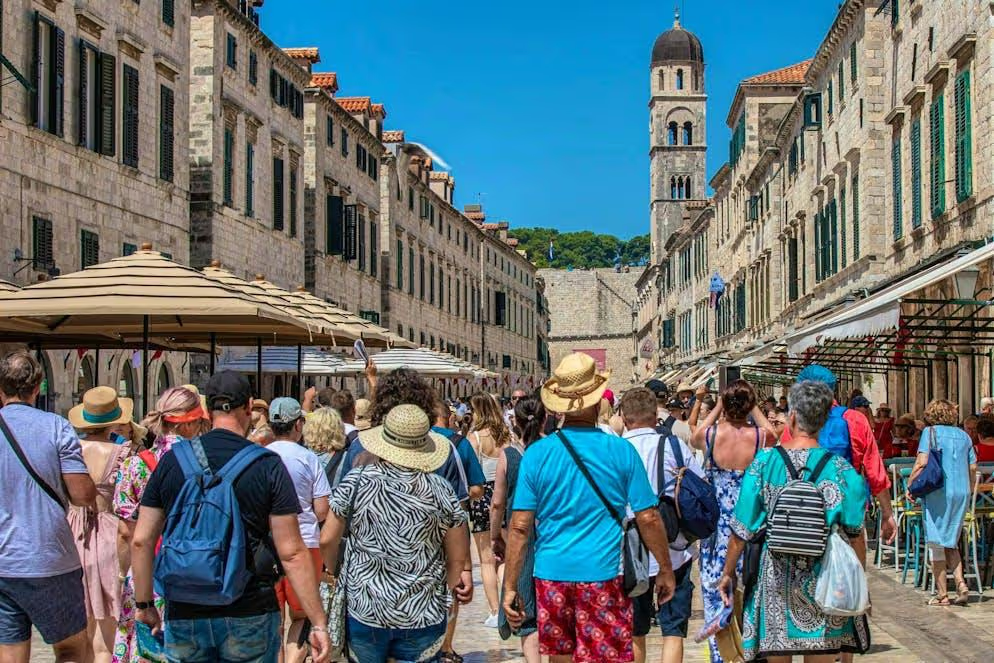
This situation was particularly striking in the Old City of Dubrovnik, a UNESCO World Heritage Site, where tourist pressure created strong tensions.
This case illustrates a key point: data is not only used to manage flows, but to arbitrate political decisions in conflictual contexts.
To the archaeological site of Lugdunum, in Lyon, access is free and without tickets, in a restricted heritage context (UNESCO, DRAC). For a long time, attendance was based solely on estimates.
The installation of sensors on several accesses made it possible to obtain an objective measurement for the first time.
Immediate result: the initial estimates were largely wrong. The site was expected to welcome around 850,000 visitors per year. The data revealed real attendance more than twice as much.
But the main lesson is not just about volume:
Consequence: the management of the site has been deeply adjusted, including on very concrete aspects (equipment sizing, procurement, internal organization).
This case illustrates a central point: before even regulating, it is often necessary to correct a poor representation of reality.
The temptation in the face of overcrowding is to close, limit, forbid. Strict quotas, dissuasive paid access, total closure of fragile sites. These measures may be justified in extreme cases (protection of critically endangered ecosystems), but they are not always necessary or desirable.
Objective measurement of attendance often makes it possible to identify soft regulation levers more effective than the ban:
Spatial distribution: Promote alternative sites to unclog iconic sites
Temporal spread: Encourage visitors to come during off-peak hours and periods
Improvement of reception capacity: Widen a trail, add sanitary facilities, reinforce signage — sometimes, the problem is not traffic but the unsuitability of infrastructure
Management of expectations: Inform visitors in advance about the expected level of attendance, so that they can adjust their expectations or postpone their visit
Adaptation of services: Size reception, maintenance and equipment to real peaks rather than to the average
The measure is therefore not an end in itself. It is a diagnostic tool that makes it possible to move from reactive and emotional management of overattendance to proactive and strategic management.
Tourist overcrowding is a real issue, which deserves to be taken seriously. But public debate often remains trapped in opposing positions: on the one hand, denial (“there are no more tourists than before”), on the other, exaggeration (“we are invaded”). Between the two, there is little room for an objective diagnosis.
Rigorously measuring attendance, analyzing its temporal and spatial distribution, distinguishing physical capacity and psychological capacity, cross-referencing data with the feelings of residents and visitors: this approach makes it possible to leave the sterile debate behind and enter into strategic management.
Territories that invest in this objectification note that it gives them unsuspected room for manoeuvre. Overattendance is not a fatality that can only be suffered or forbidden. It is a phenomenon that can be understood, anticipated and finely regulated, provided that you agree to measure it rigorously.
So the real question is not “do we have too many tourists? ”. It is “how do we better distribute flows, in time and space, so that tourist attendance remains compatible with the preservation of sites and the quality of life of the inhabitants? ”. This question can only be answered in objective data — and in the political will to exploit it.






.svg)
.jpg)







.avif)